
The Mauritius We Choose
Beyond the images of unrest, the quiet work of holding a country together.
On Wednesday morning, after the first night of curfew, I walked through Port Louis.
At ten o’clock the Victoria Urban Terminal was open. Buses were pulling in and out of their bays.
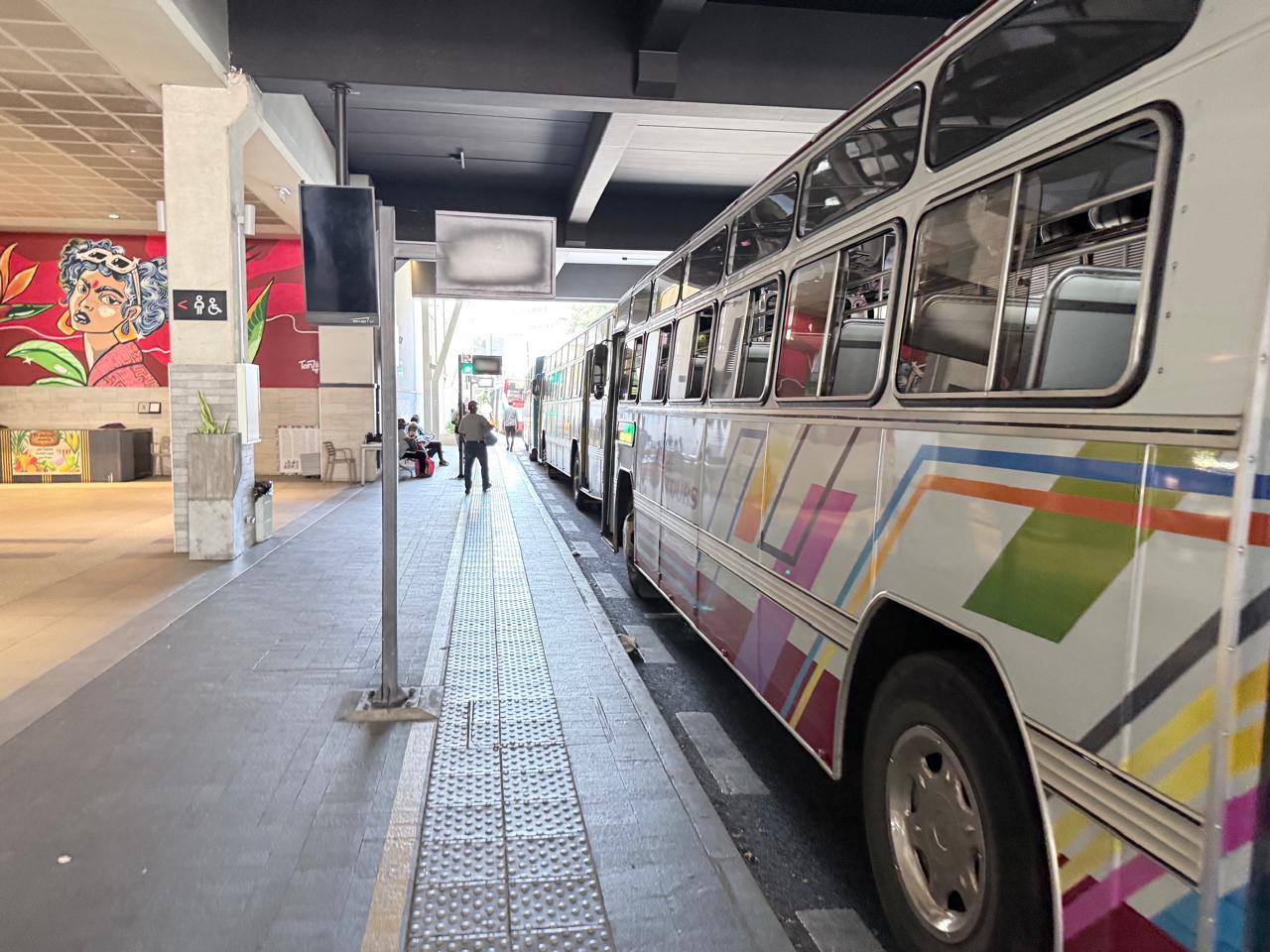
The Victoria Urban Terminal in Port Louis at ten o’clock on Wednesday 14 October, the morning after the first night of curfew.
In the market, the vendors had laid out their carrots, tomatoes and eggplants, priced and labelled as on any other morning, and people were filling their shopping bags. There were fewer people than usual and the streets were quieter, which after the nights just passed was understandable.
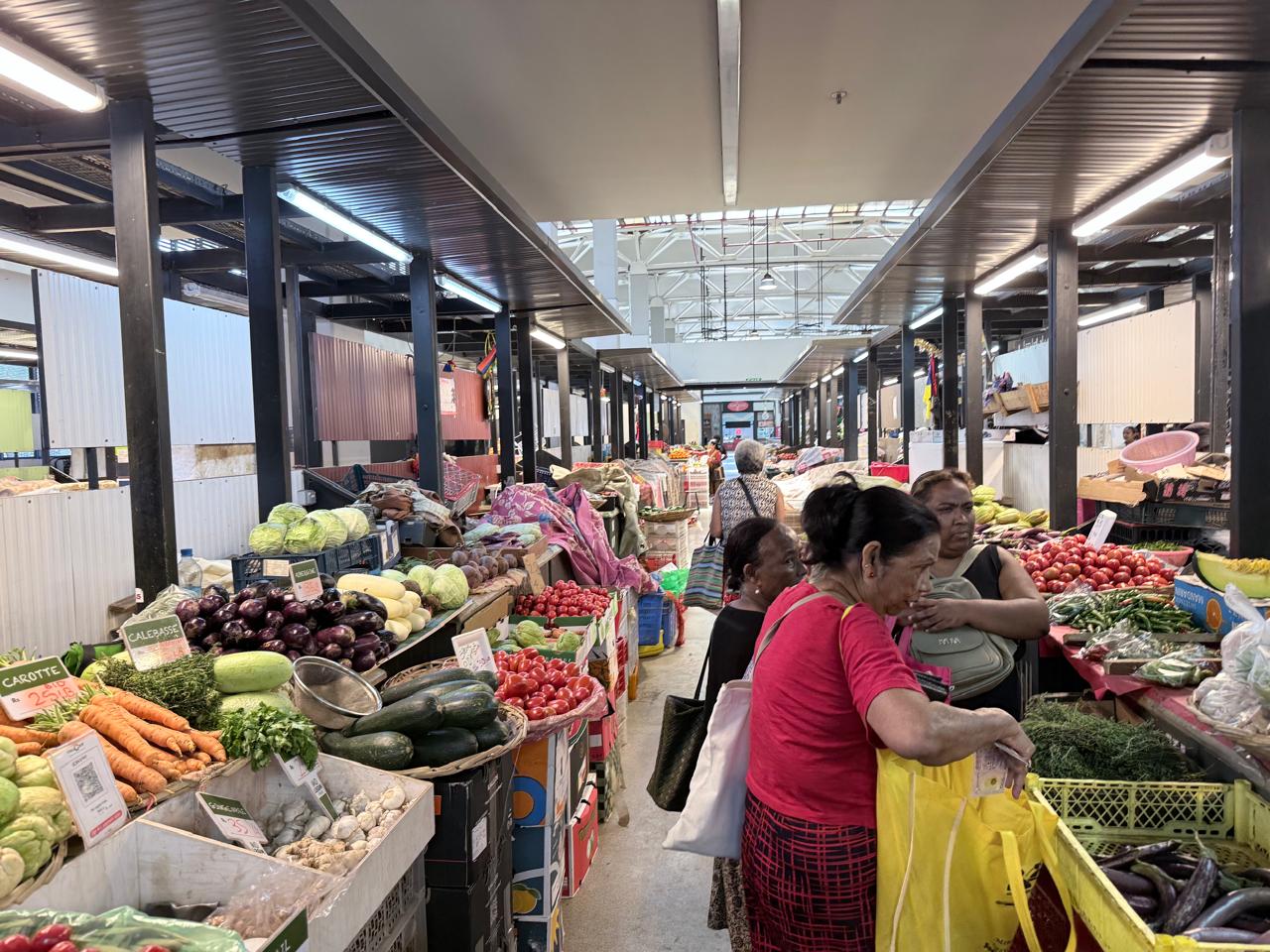
The market at the terminal the same morning. Quieter than usual, but open and trading.
But something struck me, and it is why I am writing this note. I did not find the atmosphere of fear I had been primed to expect by everything I had seen on my phone.
I cannot know what those vendors or commuters were feeling. Some may well have been anxious. Some may simply have had no choice but to carry on. But there was something important in seeing ordinary life continue, even in the shadow of uncertainty.
What the feed showed, and what the street showed
For several days our feeds had been full of disturbing images. Burning tyres, blocked roads, looted shops, police stations under attack, confrontations in the street. The same clips were forwarded again and again. The impression was of a country sliding into chaos. And yet here I was, walking through the capital, watching people buy vegetables and get on with their day.
I had a similar experience at Cascavelle. From what was circulating online, you could have imagined the whole mall wrecked. What I found was four shops that had been broken into, including a myt shop. The damage to those businesses was real, and I had a direct reason to care about it. But the mall had not been destroyed. The reality was far more contained than the impression being created.
My two visits do not represent the situation everywhere. Other areas had serious disturbances. Families were frightened. Businesses lost stock and income. Classes were suspended and examinations disrupted. These were not ordinary days, and we should not pretend otherwise.
But I came away with a question. Are we allowing the worst moments of our country to become the only story we tell about it?
There is something curious about how we experience a crisis now. A burning tyre is news. A bus arriving at its stop is not. A shop being looted attracts thousands of views. A shopkeeper lifting the shutter the next morning attracts none. A confrontation can cross hundreds of WhatsApp groups in minutes. A neighbour checking on an elderly resident is seen by no one else. Yet both tell us something true about our society.
The problem is not necessarily that the images of violence are false. Many document real incidents, and those incidents deserve attention. The problem is that a video can be entirely genuine and still leave you with the wrong picture. When the same scene circulates for the third time, what happened in one place and what is happening across the country start to blur. We end up experiencing a whole nation through its most frightening minutes, and the quieter reality of more than a million people trying to live peacefully disappears from view.
This is not an argument against journalism. We need independent reporting most in weeks like this. But information shapes not just what we know but how we feel and how we behave. Fear travels fast. So does reassurance, when it is grounded in facts.
What happened was serious. But what happened is not all that happened.
Happy Friday, neighbours
Then, this morning, a message arrived in my neighbourhood WhatsApp group.
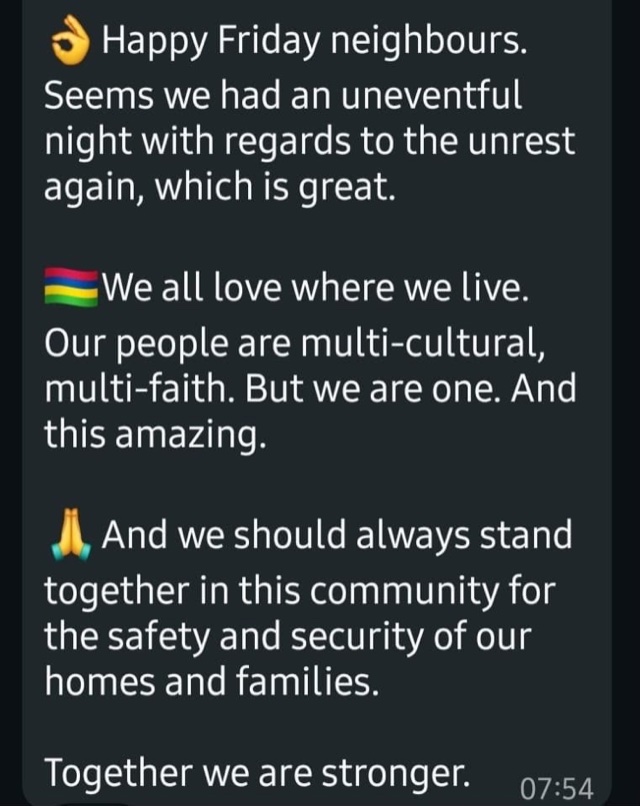
The message that arrived in my neighbourhood group at 07:54 on Friday 16 October.
It began simply: “Happy Friday neighbours.” Relief that the night had passed quietly. A reminder to keep looking out for one another. And then a few lines that have stayed with me. “We all love where we live.” “Our people are multi-cultural, multi-faith. But we are one.” “Together we are stronger.”
There was nothing complicated about it. No analysis, no blame, no grand declaration. Just a neighbour, grateful for a quiet night, reminding us what we share. And the sender is not Mauritian by birth. They came from abroad, made this country their home, and today it was they who reminded the rest of us what we have. I found it moving.
Neighbourhood groups like this one have sprung up or come alive across the island. People have been exchanging information, organising watches and checking on one another. All of that must stay peaceful and within the law. But behind it is a choice. People are choosing to look after one another, and that choice says something about who we are.
The same technology that let fear and rumour travel across the country in minutes carried this message. A WhatsApp group can be a source of anxiety or a source of reassurance. The difference is not the technology. It is what we decide to do with it.
Mauritianism is social trust
We celebrate Mauritius as a multicultural, multi-faith society, and rightly. But I wonder whether we celebrate the visible expressions of that, the festivals and the languages and the food, without reflecting enough on what makes them possible.
Mauritianism is not simply several communities sharing an island. It is their willingness to build a shared future. It is the recognition that my neighbour’s safety contributes to my own, that another family’s opportunity strengthens the whole, that the dignity of someone whose background differs from mine matters exactly as much as my own. Those are not abstractions. They are the foundations of social trust, the thing that lets businesses open their doors in the morning and buses run on time. Most of it is invisible until something threatens it, and then we discover how much of our daily life was resting on it.
Social trust is not the absence of differences. It is the confidence that those differences do not threaten our ability to live together. We sometimes describe our diversity as though it produced harmony by itself. It does not. Perhaps the greatest achievement of Mauritianism is not that we have managed to preserve our differences, but that we have learned to build something together despite them. That achievement is never permanent. Each generation inherits it and must sustain it. Every crisis tests whether the trust beneath our coexistence is as strong as we believe it to be.
None of this requires that we agree. We can disagree profoundly about the direction of Mauritius and still care deeply about its future. The test is whether we can disagree without letting our differences harden into suspicion or hostility. That is the Mauritianism worth protecting: not an idealised country without problems, but a commitment to working through them together.
The people who worked through it
Over those nights the police, the Special Mobile Force, the Special Support Unit and other services were on the streets restoring order. Several officers were injured. Police stations and vehicles were attacked. Barricades of tyres burned on roads in many parts of the island.
Someone had to put those fires out. The firefighters of the Mauritius Fire and Rescue Service went out to burning barricades, vehicles and buildings night after night, while the unrest was still under way. They do not appear in many of the clips that were shared, because a fire being extinguished is less dramatic than a fire being lit. But their work is as much a part of this week as anyone’s, and it deserves to be named.
None of this closes the questions. The many arrests made over the week, a number of them of minors, must each go through a proper judicial process. The police sergeant involved in the shooting of Élodie Thomas on 9 October has been provisionally charged. The shooting intensified tensions that had begun over water shortages and the cost of living. There will be legitimate questions about the timing and effectiveness of the response, just as there must be accountability for what came before it. The rule of law protects us against violence and against the misuse of authority, and it only works when it does both.
The work that remains
The grievances underneath the week are real. People have reasonable expectations of water in their taps, of being able to afford to live, and of fair treatment by the institutions they pay for. Those expectations cannot be waved away because some of what followed turned violent. People must be able to express their frustrations peacefully and have their concerns taken seriously. At the same time, frustration does not justify looting, arson or attacks on people and property. We have to be able to hold both. Understanding a grievance is not the same as excusing violence, and condemning violence is not the same as dismissing the grievance.
This brings me to the distinction that matters most. Restoring order is necessary. Restoring trust is the larger task. Order can be restored by policing and a curfew. Trust requires institutions that listen, services that work, opportunities that are reachable, and a public culture in which people believe they will be heard without anyone having to burn anything. The absence of unrest is not the absence of discontent, and a peaceful country should aspire to more than a country where nothing is on fire.
As the week recedes, the conversation will turn to blame, and I hope we resist rushing towards the explanation that confirms what we already believed. It is easy to blame a group. It is much harder to understand the circumstances that produce a crisis, and what has to change. We should be especially careful how we talk about young people. Those responsible for criminal acts must be held accountable under the law. But the young people appearing in police reports should not be allowed to define an entire generation. Across Mauritius, countless others spent this week studying, working and supporting their families. A nation cannot rebuild trust on rumour and convenient explanations. It needs facts, accountability, and the humility to accept that complex problems rarely have simple causes.
The morning after
I keep returning to that message. “We all love where we live.” Beneath our opinions and frustrations there is a shared attachment to this country, and it deserves to be nurtured through the choices we make and the responsibilities we accept.
The clips will fade from our feeds. There will be investigations and difficult questions, and there must be. But I hope we also remember what happened beyond the headlines. The vendors who opened their stalls. The drivers who ran their routes. The firefighters who went out to the barricades. The officers who stood in places most of us would rather avoid. The neighbour who sent a message at eight in the morning to say the night had been quiet. None of these were dramatic acts of heroism. They were people doing what needed to be done. The resilience of a society is found in the ordinary things its people keep doing when circumstances turn difficult, and we should not overlook it just because it generates no views.
I do not believe the spirit of Mauritianism went anywhere this week. I saw it in a market, at a bus terminal and in a WhatsApp group. Mauritianism is not something we invoke only at celebrations. It is something we practise, often without noticing, in the ordinary choices we make for one another. We do not have to choose between acknowledging what is wrong with Mauritius and believing in what is right about it. We have to do both.
A country is not defined only by what happens on its worst nights.
It is also defined by what its people choose to do the morning after.