
From Sugar to AI: How Mauritius Keeps Moving Up
A field note from DTW Ignite in Copenhagen, on a small country that has kept reinventing itself, and is now being asked to do it again with AI.
I was in Copenhagen last week for TM Forum’s DTW Ignite and gave a keynote on how Mauritius is using AI. I had the obvious material ready: myt Learn, the personal AI tutor for school kids; the AI Registry the country is setting up; the training numbers in the national budget.
But as I stood in front of a room of telecom and technology leaders, I realised the deeper story was older than any of these initiatives.
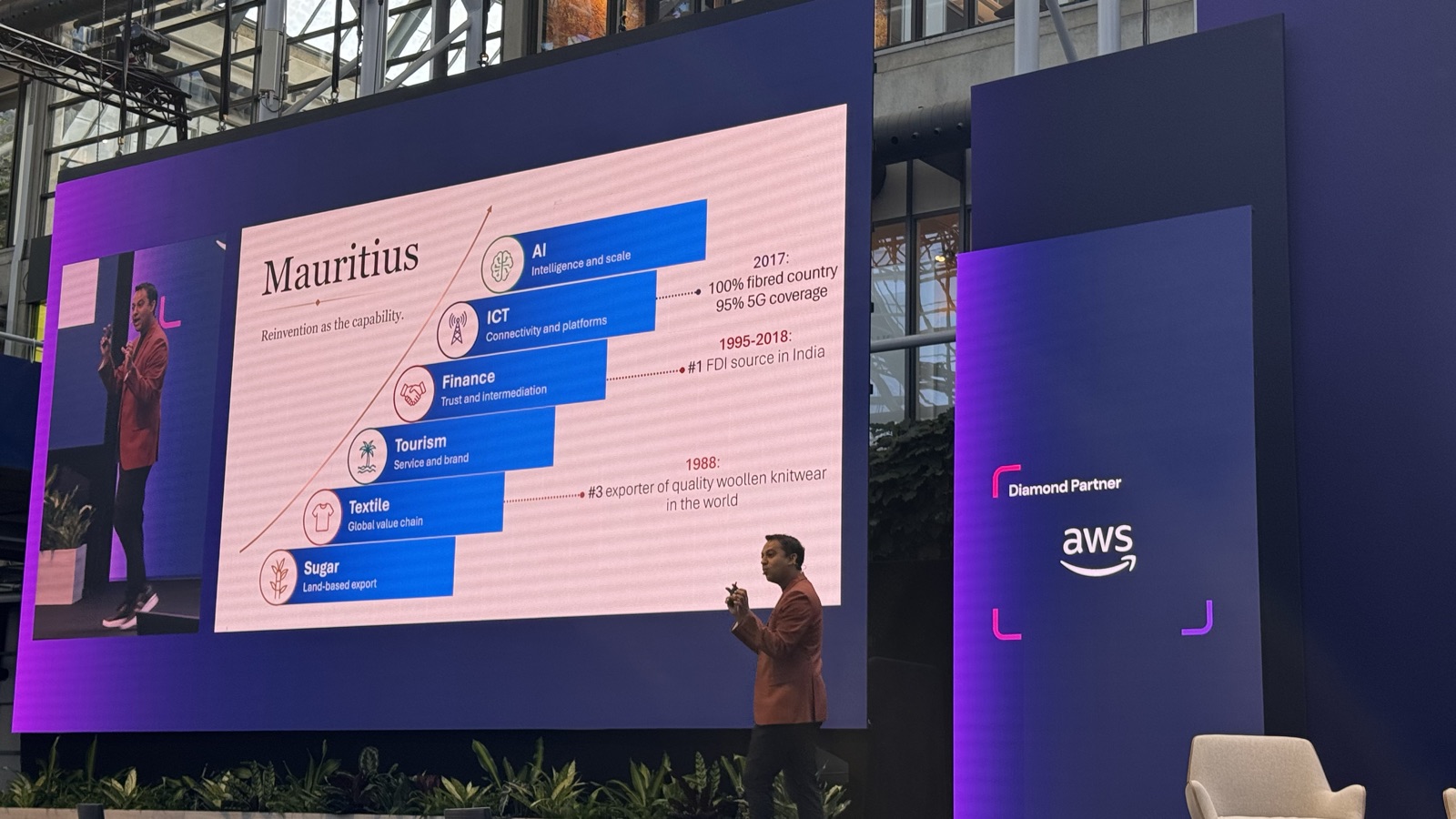
On stage at TM Forum’s DTW Ignite in Copenhagen, walking through Mauritius’s climb up the value chain, from sugar to AI.
There is a story Mauritius does not tell itself often enough. We did not progress because we had size. We had no oil, no minerals, no large domestic market. What we had, again and again, was the ability to learn a new national capability before the old one was no longer enough. That, more than any single industry, may be our most important asset.
A small island that kept moving
We began with sugar. For generations it was more than an industry. It shaped the land, the exports, the institutions and our place in the world. But a country cannot remain only a sugar economy, so we moved.
We built textile and manufacturing, and entered global value chains. We learnt that a small island could produce for the world. Then we built tourism, and turned beauty, service and a national brand into economic value, which is to say we learnt standards, training, air access and the confidence to present ourselves to the world. Then we built financial services, and learnt intermediation: how a small country creates value by being reliable, connected and trusted. Then we built digital connectivity.
Each move looked difficult at the start. Each required public decisions, private investment, institutional patience, and people willing to learn skills they did not yet have. Each one created anxiety. And each one moved the country into a new layer of value.
Quiet infrastructure first
The connectivity chapter matters more than we usually credit, because it shows how this kind of progress actually happens.
In 1987, the first inland fibre link was laid from the international gateway to the telephone exchanges in Port Louis. Telecommunications was still scarce and expensive then, the concern of government, business and institutions rather than households. Then came a lesson. In February 1994, Cyclone Hollanda tore through much of the microwave infrastructure carrying local connections between exchanges. For a country in the path of cyclones, that was not only a technical vulnerability. It was a national lesson. If Mauritius wanted to stay connected through its hardest moments, it needed a more secure backbone.
So roads were dug, pipes were laid, exchanges were connected, and microwave links were replaced with fibre. The purpose was not glamour. It was resilience. That is often how national progress arrives: quiet infrastructure first, visible transformation later.
The backbone made the next thing possible. As internet use emerged from 1996, connectivity stopped being about making calls and started becoming the base layer of economic participation. In 2002 the SAFE submarine cable came into service, linking South Africa, Mauritius, Réunion, India and Malaysia, and placing the island on a strategic route between Africa and Asia. That cable was a statement about geography: Mauritius was no longer only an island in the Indian Ocean, it could be a digital bridge. By the end of 2017 the country had full fibre coverage. For a small island state that was not a minor technical milestone. It meant digital access was no longer the privilege of a few districts and offices. It had become national foundation.
Sugar gave us land-based exports. Textile gave us value chains. Tourism gave us service and brand. Finance gave us trust and intermediation. ICT gave us connectivity and platforms. The next frontier is artificial intelligence.
AI is not just a productivity tool
AI is a productivity tool, and a real one. It helps people write, analyse and respond faster, and it automates routine work. But for a country that has kept moving up, productivity is only the beginning of what matters.
The real question is not how we use AI to do the same things faster. It is whether we can use it to move up the value chain again. How do we help students learn with more support, and teachers prepare and personalise? How do small businesses reach customers, understand markets, translate content and compete with larger firms? How do public officers deliver services that are faster and more responsive? How do hotels, banks, ports, hospitals, farms and telecom networks become more intelligent in how they operate? How do we create new services from Mauritius for the region, rather than only consuming demonstrations built elsewhere?
That is the AI question worth asking. Not AI as a fashionable technology, but AI as a new layer of national capability.
What the numbers could become
This is why the emphasis on AI in the national budget matters: it gives the country a direction to build on. The budget sets out to train and enable 50,000 Mauritians in practical AI over the coming year. Within that, 25,000 are to be trained in practical AI skills, including developers, entrepreneurs, SME owners, professionals, and workers whose jobs are already being reshaped, and 5,000 public officers are to be trained to use AI safely and responsibly.
The numbers matter because of what they can become, which is more than a training target. Fifty thousand people who are genuinely comfortable with these tools can change a country’s confidence. It can mean teachers who prepare better lessons, students who learn with more help, civil servants who serve citizens faster, and SME owners who can market, analyse, translate and design with tools that used to belong only to large companies. It can mean young people building products and content at a far lower barrier to entry, and professionals moving from routine work toward judgment, creativity and problem-solving. That is how a country moves up. Not by waiting for the future to arrive fully formed from elsewhere, but by preparing its people to take part in it.
myt Learn is one early, concrete version of this. An assistant that began as mytGPT Education is, at bottom, a bet that the fastest way to raise national capability is to put a capable tool directly in front of learners and let them build the habit.
The harder questions
Training alone will not be enough. AI needs its own foundation, the way every reinvention before it did. Sugar needed mills, markets and labour. Textile needed factories and trade access. Tourism needed hotels, airlines and standards. Finance needed treaties, regulation and trust. ICT needed cables, exchanges and fibre. AI will need compute, data centres, cybersecurity and connectivity, and it will need institutions that understand accountability and responsible deployment, and local use cases rather than imported ones.
It will also need us to ask harder questions. What data should remain sovereign? Which AI systems can be trusted, and how would a citizen, a business or a regulator even know? How do we protect people while encouraging innovation, and make sure the next layer of value is created in Mauritius and not only consumed from elsewhere?
This is where the AI Registry the country is standing up stops being administrative and starts being strategic. I have argued separately that as AI makes software cheap to create, institutions will create far more of it, more tools, agents and skills, and the binding question becomes discovery: knowing what exists, who owns it, and whether it can be trusted. A small state that gets that layer right early gives itself something larger states are still improvising. None of these questions are reasons to slow down. They are reasons to build properly.
Moving up again
This is the thought I carried with me in Copenhagen.
Mauritius should not approach AI as a country trying to follow a trend. We should approach it as a country that recognises a familiar moment.
The old foundations are not disappearing. Sugar, textile, tourism, finance and ICT still matter. But each phase of our development taught us something important: the countries that move up are not always the biggest. They are the ones that learn early, organise seriously, and design the advantage the next economy requires, rather than waiting to inherit it.
AI is now asking that of us.
It is asking whether we can give our people the confidence to use it well. It is asking whether our institutions can become more responsive. It is asking whether our businesses can create higher-value services. It is asking whether Mauritius can be more than a consumer of technologies built elsewhere.
The answer will not come from one platform, one budget line, one institution or one speech. It will come from whether we can turn this moment into a national habit of learning.
That is what Mauritius has done before. We moved from land to factories, from factories to service, from service to trust, from trust to connectivity. Now we have to move from connectivity to intelligence.
Not because AI is fashionable, but because moving up is how Mauritius survives, grows and stays relevant.
That is the island’s real story, and it is being asked to write the next chapter now.
A version of this article appeared in l’express on 29 June 2026.